Well Pump Repair in St George, UT
Well pump repair in St George, UT. We diagnose low pressure, no water, and short-cycling on private wells across Washington County. Call to get water back.
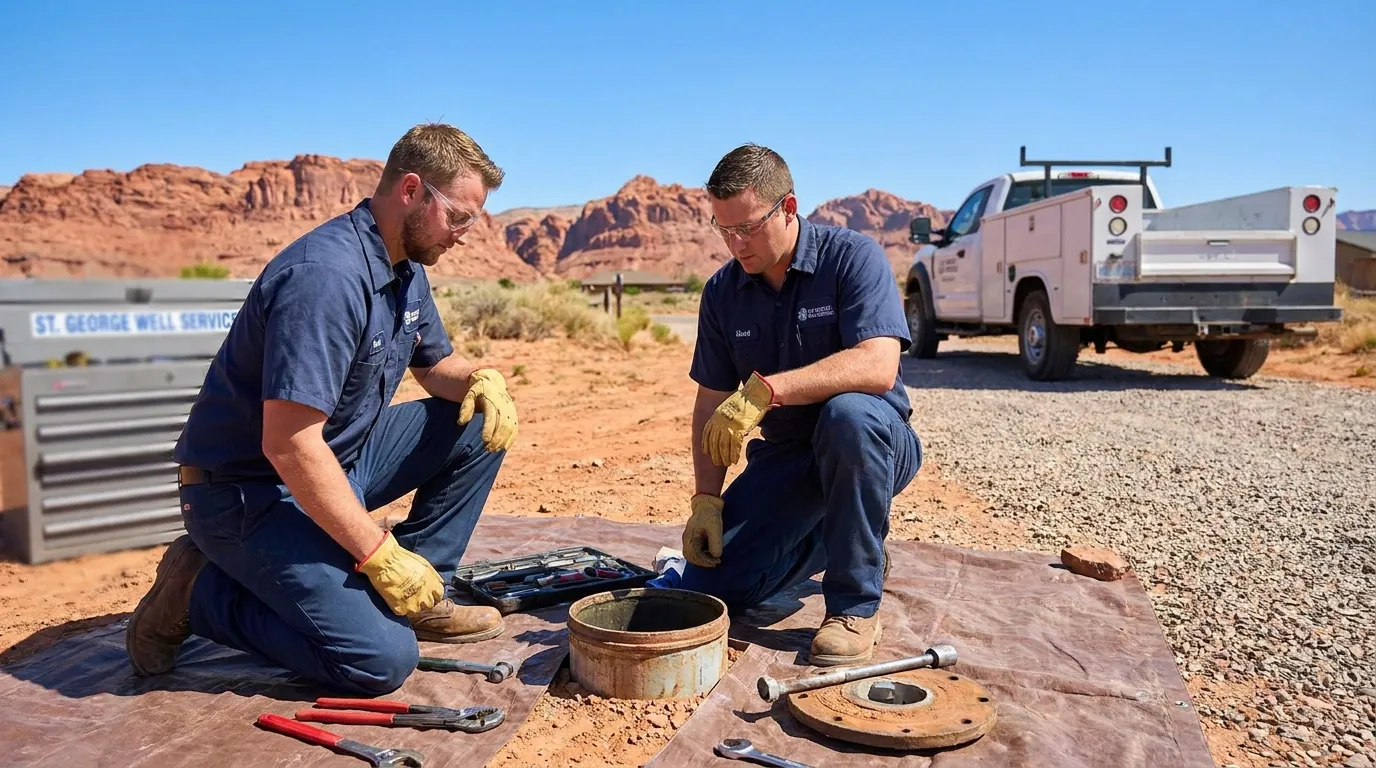
When you need well pump repair
A well pump rarely fails without warning. The trouble usually shows up first as symptoms most homeowners can spot: pressure that sags when two fixtures run at once, a pump that runs constantly or clicks on and off every few seconds, water that sputters air, discolored or sandy water, or a spike in the electric bill from a pump that never rests. Left alone, these small signs turn into the one symptom nobody can ignore: no water at all.
Repair well pump work starts with an honest diagnosis. "No water" can mean a tripped breaker, a failed pressure switch, a waterlogged tank, a bad check valve, a burned-out motor, or a well whose water level has dropped below the pump. Those are wildly different fixes, and pulling a pump you did not need to pull is expensive. Good pump and well repair means reading the system before touching it: checking power, pressure, amp draw, and tank charge to find the real cause.
How we approach a well pump repair
Every repair follows the same logic — confirm the symptom, isolate the cause, then fix the part that actually failed.
-
Confirm the symptom and check the easy things
We verify power, the breaker, and the pressure switch first. A surprising share of no-water calls come down to a tripped breaker or pitted switch contacts, which are common on our hard water and cost far less than a pump.
-
Read the pressure system
We test the pressure tank's air charge and the switch settings. A waterlogged tank or a mis-set switch causes short-cycling that mimics a failing pump and wrecks the pump if left running that way.
-
Measure the pump's electrical draw
Amp readings tell us whether the motor is healthy, straining against scale and sand, or open. This decides whether the fix is at the surface or down in the well.
-
Inspect down-well components when needed
If the readings point below ground, we assess the pump, wiring, check valve, and drop pipe. On sandy wells we look closely at worn seals and impellers eroded by grit.
-
Repair or replace the failed part
We fix what failed: a switch, tank, check valve, capacitor, or wiring at the surface, or the pump itself if the motor is gone. If the pump is at end of life, we discuss replacement rather than a short-lived patch.
How St George conditions drive pump failures
The failures we see most in this area trace back to two things: mineral-heavy water and summer demand. Alkaline, hard groundwater deposits scale on pressure switches, check valves, and tank fittings. Scale roughens surfaces, sticks moving parts, and makes the pump work harder every year. That extra load shows up as higher amp draw long before the motor quits. Sandy wells add abrasive grit that wears impellers and seals, which is why sand in the water is often an early repair warning rather than a nuisance.
Timing matters too. Our arid summers push wells hard — irrigation, evaporative coolers, and full households all draw at once — so a marginal pump that survived a mild winter frequently fails in the July heat, exactly when an outage is worst. In the higher, colder parts of the service area around Toquerville and La Verkin, winter freeze adds a different failure: cracked pressure lines and split tanks on systems that are not protected from the cold.
If your last visit was a routine well pump service, a repair is usually quick because there is already a baseline to compare against. And when a diagnosis shows the pump has simply reached the end of its life, repairing it again rarely pays — that is the point to consider well pump installation and a properly sized replacement for your well and household.
Get your well pump repaired
Low pressure, short-cycling, or no water? Call to describe what you are seeing and we will help figure out the fastest path back to steady water.
Serving St George and nearby Washington, Hurricane, Toquerville, La Verkin, Virgin, and Apple Valley.
Frequently asked questions
Why do I suddenly have no water from my well?
Common causes include a tripped breaker, a failed pressure switch, a waterlogged pressure tank, a bad check valve, or a burned-out pump motor. It can also mean the water level dropped below the pump. Because the fixes differ greatly, a proper diagnosis comes first.
Is my low pressure a pump problem or something else?
Low pressure can come from a failing pump, but also from a waterlogged tank, a clogged filter, scale-narrowed pipe, or a misadjusted pressure switch. Measuring pressure and amp draw separates a pump issue from a surface issue before anyone pulls the pump.
Should I repair or replace my well pump?
If the pump is otherwise sound and a surface part failed, repair makes sense. If the motor is burned out or the pump is old and scaled, replacement usually costs less over time than repeated repairs. We explain what the diagnosis shows so you can decide.
Does sandy water mean my pump is failing?
It can. Sand often points to worn pump components, a failing well screen, or a low water level drawing sediment. In our sandy formations grit accelerates wear, so sand in the water is worth investigating rather than ignoring.