Submersible Pump Service in St George, UT
Submersible well pump service in St George, UT. Warning signs, what pulling and servicing a downhole pump involves, and how local water affects it.
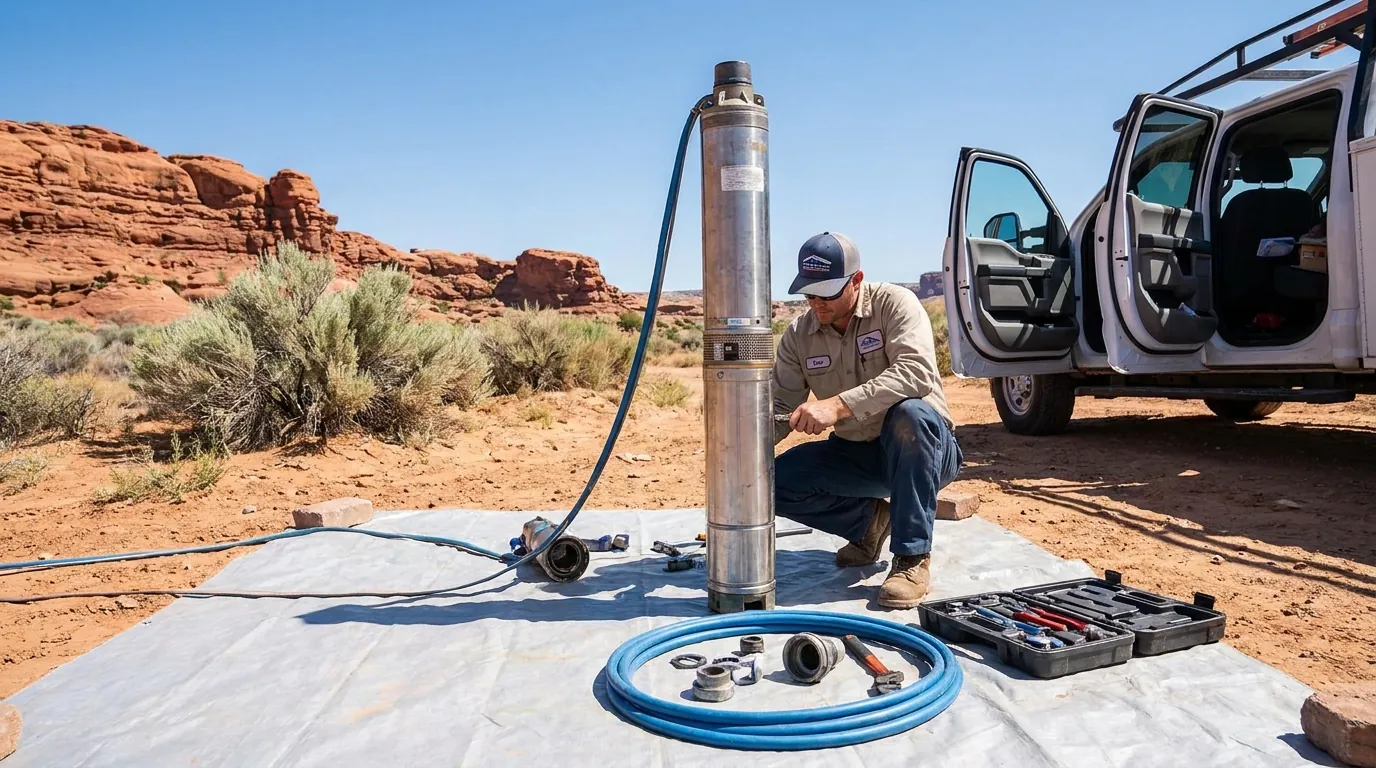
The pump you never see
Most private wells in this region use a submersible pump — a sealed motor and pump unit set deep in the water at the bottom of the well. Because it's out of sight, trouble shows up indirectly: the breaker trips, the water sputters with air, flow fades, sand appears, or the pump runs but delivers nothing. Servicing a submersible is different from surface equipment because reaching it means pulling the pump and drop pipe, so the diagnosis before that step matters a great deal.
We never pull a submersible until we've confirmed the fault is actually downhole. Many apparent pump failures are a surface problem — a bad control box, capacitor, switch, or waterlogged tank. We test those first, and only when the fault is clearly at the pump do we open the well. If a surface part turns out to be the cause, that's a quick well pump repair instead of a major job.
What submersible pump service involves
When the pump itself has to come up, here's what happens.
-
Confirm it's downhole
We test the control box, wiring, and surface components first. Only when the readings point clearly to the pump or its cable do we pull it.
-
Pull the pump
The pump is raised on its drop pipe and safety rope. We inspect the motor, the wiring splice, the check valve, and the intake screen as they come up, noting scale and sand wear.
-
Service or replace
Depending on what we find, we service the pump and its components or, if the motor or pump end is spent, fit a correctly sized replacement with fresh pipe, wire, and check valve.
-
Reset and verify
The pump is lowered to the right depth, wired, and tested against proper amperage and pressure, with the pressure tank and switch set to protect it going forward.
How local water affects a submersible
A submersible lives in your well water full time, so the quality of that water drives its wear. The hard, alkaline water common across St George leaves scale on the impellers, check valve, and intake, which slowly robs the pump of capacity. Sandy, abrasive soils are harder still: grit drawn through the pump wears the moving parts and can score the motor's seals, which is why a pump that pumps sand needs attention before the abrasion spreads.
Setting depth matters too. In deep wells with a low water table — common on some properties around Hurricane, Virgin, and Apple Valley — the pump has to lift water a long way, and a pump set at the wrong depth either draws air or works too hard. When we service a submersible we confirm it's set correctly for your well. Ongoing pressure tank service protects it from the short-cycling that wears motors fastest.
Think your submersible pump is the problem?
Before we pull anything, we confirm the fault is really downhole. Tell us what your system is doing and we'll start with the simplest checks.
Call to describe your symptoms and schedule service.
Frequently asked questions
How do I know the problem is the submersible pump and not something at the surface?
You often can't tell from the symptoms alone, which is the point of testing first. A tripping breaker or lost pressure can come from a surface control box, capacitor, switch, or tank just as easily as from the pump, so we measure before pulling anything.
How long does a submersible pump last?
Many give years of reliable service, but life depends heavily on water quality, how often it cycles, and whether it was sized correctly. Hard water and sand in this area shorten that life, which is why we watch for scale and grit.
Why is there sand in my water?
Sand usually means grit is reaching the pump through a worn intake screen or a compromised well, and it accelerates wear on the pump's moving parts. It should be investigated rather than filtered and ignored.
Is pulling the pump always necessary?
No. We only pull the pump when the fault is clearly downhole. Confirming that first often saves a homeowner the cost and disruption of a full pull when a surface part was actually to blame.